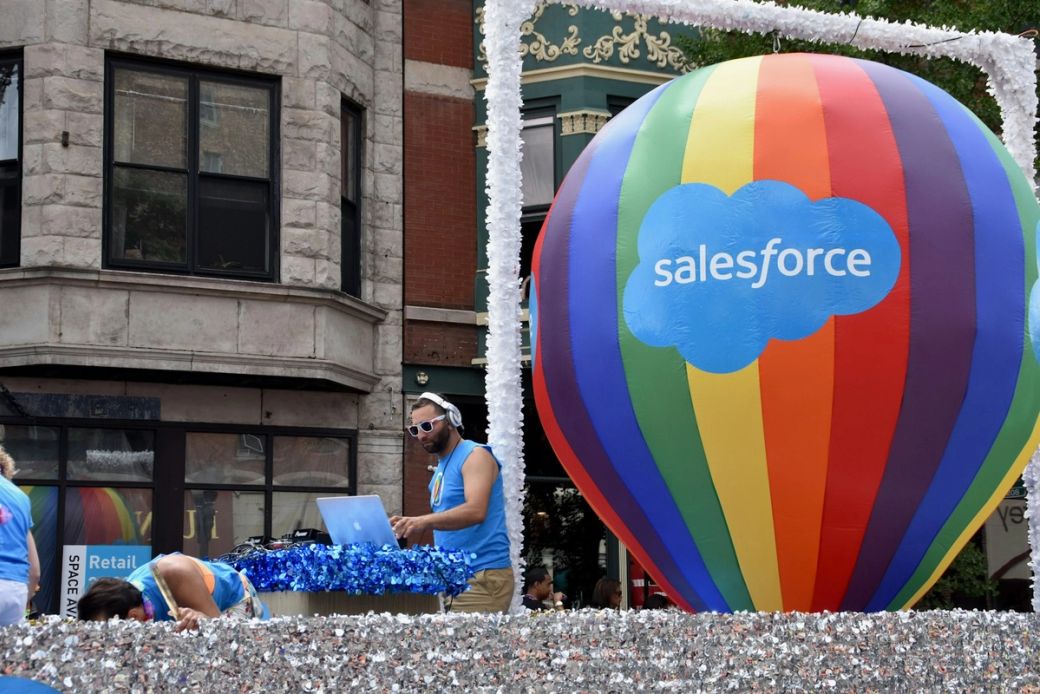
Salesforce is rebuilding its business around software that customers may never need to look at.
The customer-relationship management (CRM) giant is pursuing a "headless" strategy that lets AI agents use its data and workflows without anyone opening its app.
The move is a response to a threat facing the whole enterprise software industry: if AI does the work, fewer people need to log in.
What headless means
Traditional business software has two parts: a back end holding data and processes, and a front end, or "head", where staff click through screens.
Going headless means separating the two, so the back end can be reached directly.
Salesforce unveiled the approach as Headless 360 at its TDX developer event in April and rebranded it AIforce in September.
It lets AI agents, software that carries out tasks on a user's behalf, act on Salesforce data from inside tools such as Slack or Anthropic's Claude.
Those agents connect through application programming interfaces (APIs), the Model Context Protocol, a standard for linking AI models to outside systems, and command-line tools.
Why Salesforce is doing it
Work is starting to move into AI assistants, and Salesforce wants to be wherever that work happens.
If staff ask Claude or a Slack agent to update a sales pipeline, Salesforce either supplies the data or gets bypassed.
Opening the back end makes its customer data the system of record every agent relies on.
Management argues that agent-driven automation expands the economics of enterprise software rather than eroding them.
Annual recurring revenue from Agentforce and Data 360, its AI and data products, has climbed to nearly $3.4 billion.
The risks
The biggest risk sits in the pricing model, which has long charged per user, per seat.
If agents do work that people once did inside Salesforce, customers may need fewer seats.
Losing the screen also means losing the place where Salesforce shows customers new products and sells upgrades.
There is a danger it becomes plumbing behind someone else's interface, useful but easier to squeeze on price.
Switching to consumption-based or agent-based pricing is messy, and revenue can dip before a new model beds in.
The opportunity
If it works, Salesforce becomes harder to replace, not easier, because every agent needs its data.
Usage-based pricing would let revenue grow with agent activity rather than customer headcount.
It also keeps Salesforce relevant regardless of which AI assistant wins the interface battle.
What the market thinks
Investors are not yet convinced, with the shares down roughly 14% this year and stuck in a narrow range since the Dreamforce conference in early September.
Goldman Sachs analyst Gabriela Borges has a buy rating and a $271 price target, but said the strategy is unlikely to lift revenue in the near term.
Goldman's target has moved from $330 in February to $242 in July, before rising after second-quarter results for the 2027 financial year in late August.
The bank said Salesforce is still proving product-market fit and how to make money from AI, so the contribution will build gradually.
Revenue estimates for the 2028 financial year will be the next test.